Seaglider Ballasting Procedure
Before a sea trial, a Seaglider needs enough lead trimmed out (or in) that its maximum internal volume (volmax) gives the right thrust in the density of the water it's actually deploying into. This page covers the tank procedure for estimating volmax and turning it into a weight change. Once the glider is in the water, trim is refined dynamically from flight data — see Trim & Flight Model.
Source
Paraphrased from the APL-UW IOP office-hours session on ballasting and volmax estimation (June 2026) and the APL-UW IOP SGX Documentation. The tank method is deliberately simple — IOP's own philosophy is to nail down volmax in the tank and let the sea trial work out pitch/roll trim dynamically, rather than trying to model static centers precisely on paper. The neutral-point tank test and leash-check sections draw on operator service correspondence (2018–2023). Numbers quoted here are IOP starting points — confirm against the Parameter Reference Manual and defer to APL-UW IOP guidance.
Equipment
- A freshwater tank large enough to fully submerge the glider vertically (deep enough that it can hang without touching bottom or breaking the surface). Around 2 m is the practical minimum — that is what the glider needs to take up its nose-down surface attitude (roughly 60–70°) clear of the floor. A 3–4 m tank allows short "dives", but they tell you little that the static test doesn't. Shallow above-ground pools (~1.4 m) have been used, but they limit what you can check.
- A hanging scale or load cell suspended over the tank, to weigh the glider in water.
- A line to suspend the glider from — tied off at the rudder, since it hangs vertically.
- The glider's comms cable, connected and slack — you need a live link to read/set VBD position while the glider hangs in the tank. Leave the antenna disconnected and simply let it dangle; nothing should be expressing at the surface.
Procedure
- Weigh the whole glider dry — wings, rudder, everything — on a scale in air. This is the mass M.
- Soak it overnight, fully submerged and vertical, in the freshwater tank. This clears trapped air bubbles and fully saturates the fairings so the next day's in-water weight is real.
- Compute the tank water density. In a freshwater tank, temperature alone gives you density; a saltwater tank also needs salinity.
- Weigh the glider in water at an intermediate VBD position (e.g. 2000 A/D counts) — this is Wi. Hang it from the rudder by a light line with the comms cable attached and slack, nothing touching the tank bottom or breaking the surface.
-
Compute
volmax:where
VBD_CNV = −0.2453 cc/AD count(the old rule of thumb is roughly 4 A/D counts per cc),$VBD_MIN(~400 counts) is bladder full, and$VBD_MAX(~3960 counts) is bladder empty — note the counter-intuitive naming: smaller counts mean more volume. -
Repeat at several VBD positions — IOP uses five, e.g. 2000, 2250, 2500, 2750, 3000 counts — and average. They should agree to within about ±5–10 cc; if one is a clear outlier, re-check that measurement before trusting the average.
- Convert to a weight change using the Ballast worksheet in vis: feed it the tank
volmax, plus your target thrust and target deployment density, and it returns how much lead to add or remove.
This estimate is not precise — plan around it
IOP's own tank estimate is only accurate to roughly ±100 cc. Always deploy a glider that has only been tank-ballasted on a line, and prefer a shallow, enclosed, local first dive over an open-ocean or deep first mission — the tank number is a starting point for a sea trial, not a guarantee of neutral buoyancy in the field.
Alternative: the neutral-point tank trim test
Instead of (or as well as) weighing in water, many teams trim the glider free-floating in the tank and read off the centers directly. It answers a slightly different question — "where are neutral and level for this exact configuration?" — and its output feeds straight into the trim sheet, which then extrapolates to ocean density. It's the natural test for a glider that has just been refitted or refurbished.
Before the tank
- Inventory the variable ballast. Weigh and photograph every lead bar and foam piece and note where each sits (see inventory).
- Weigh the wings and rudder separately, then weigh the whole glider in air — wings, rudder, every screw. (On one glider the in-air weight was off by a single missing screw; it was found because someone looked.)
- Update the trim sheet with all of the above so you have a predicted
$C_VBDand$C_PITCHfor the tank's density.
In the tank — comms cable attached and slack:
- Lower the glider in with the VBD at maximum buoyancy and work out any trapped air.
- Take several CTD samples to get the tank density (temperature alone if it's fresh water). Some groups keep their own CTDs out of shared tanks because of contamination concerns — cover or isolate sensors if your tank isn't clean.
- Step the VBD toward heavy, letting the glider settle at each step, until it hangs neutral mid-water — neither rising nor sinking. Bracket it: overshoot, come back in smaller steps (e.g. 300 → 100 → 0 → −50 → −100 → −75 → −85 cc). Record every step.
- Move pitch until the glider sits level, again bracketing.
- Sweep roll to both ends and back to centre, and confirm it hangs upright at the roll center.
- Note the observed
$C_VBD,$C_PITCH,$C_ROLLand the tank density. Return VBD to full buoyancy, pitch forward, and run a quick sensor check while you have the glider wet.
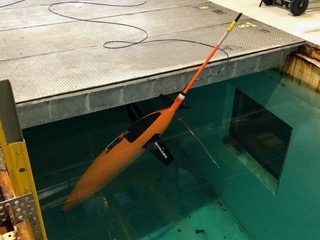
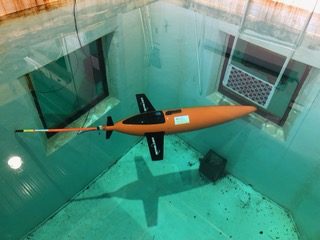
Comparing observed with predicted. On one refurbished glider the sheet predicted $C_VBD 2868 / $C_PITCH 2754, and the tank gave 2810 / 2843 — a few tens of counts on VBD, ~90 on pitch. The sea trial that followed, in water almost the same density as the tank, flew happily at 2868 / 2794. The basestation's suggestions on that trial ranged further (2934–2972 for $C_VBD) but were based on few dives; treat early suggestions as a reference, not an instruction. Once the sheet is forced to match the observed tank centers, it can be used to answer "what if" — e.g. ocean density plus an extra 100 g of lead gave ~314 cc of maximum thrust for that glider, which was judged acceptable.
Before the open-water launch: the leash check
Even a careful tank result can be off — one glider's tank test called for removing 185 g of foam, and at sea it was clearly too heavy. Plan for that:
- Carry spare foam, lead, and the tools to fit them on deck. The deployment crew should know how to open the fairing and where pieces go. If the margin is uncertain, adding a little foam before launch (~50 g) is cheaper than a recovery.
- From a small boat: with a line still attached, push the glider down by the antenna mast to ~5 m and let go. If it comes back up readily and settles into a good surface attitude, release it.
- From a large ship, where you can't handle the glider in the water to clear bubbles: make the first dive on a long line, accept that this dive is only for purging air, and judge ballast from the dives after.
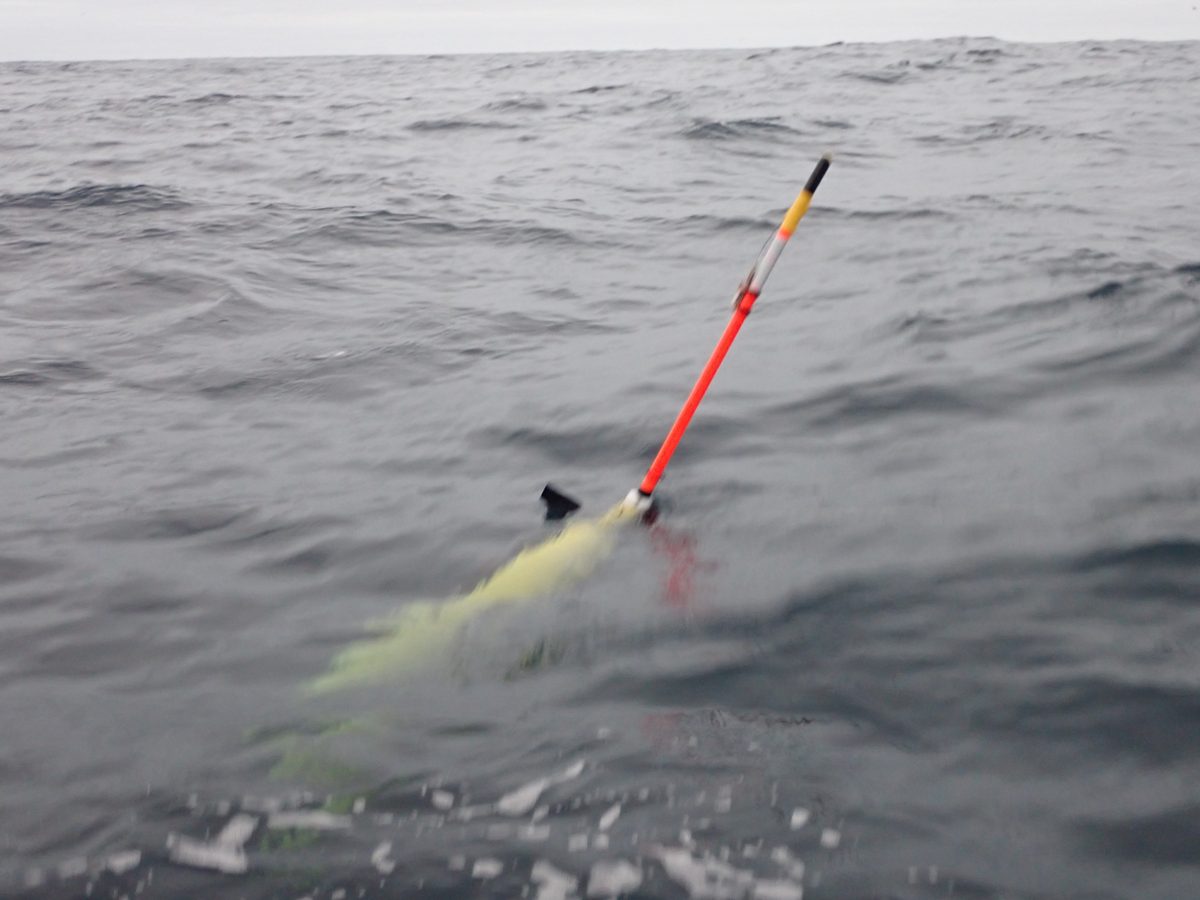
- Judge surface attitude knowing the VBD position. A glider that has failed to call or get a GPS fix may keep pumping toward full buoyancy, so check where the VBD actually is before deciding. If it sits very low (tail fin mostly under) at full VBD, it is too heavy — recover and add foam. One team added foam in ~60 g steps between checks before launching.
- Don't over-read the picture. A correctly ballasted Seaglider floats low: most of the hull awash, only the antenna mast and the top of the rudder clear. What matters is that the mast stands well out of the water at a steep angle — and that no air is trapped to flatter the result.
For a glider whose first mission has to go ahead without a sea test, at least run an autonomous self-test and several simulated dives, then update $MASS, $C_VBD and $C_PITCH (and sg_calib_constants.m) from the tank results before shipping.
After the tank: dynamic trim
The tank only gets volmax roughly right. Everything else — pitch trim, roll trim, and refining volmax itself — is worked out dynamically from the first dives, using the FMS regressions described on the Trim & Flight Model page. Expect the physical process (cutting foam, moving lead) to take several iterations before the glider floats the way you want, the same way a Slocum typically needs several tank opens before its ballast is right.